You know those dishes that completely change the way you eat at restaurants?
Beef pho is one of them.
Once you make it at home and taste that deep, fragrant broth that’s been simmering for hours, you’ll sit down at your next pho restaurant and think… this is fine, but it’s not the same.
And honestly? That’s a good problem to have.
This recipe walks you through everything, including the charring trick most people skip (don’t skip it), the spice bundle that makes the whole pot smell unreal, and how to get that perfectly clear, golden broth at home.
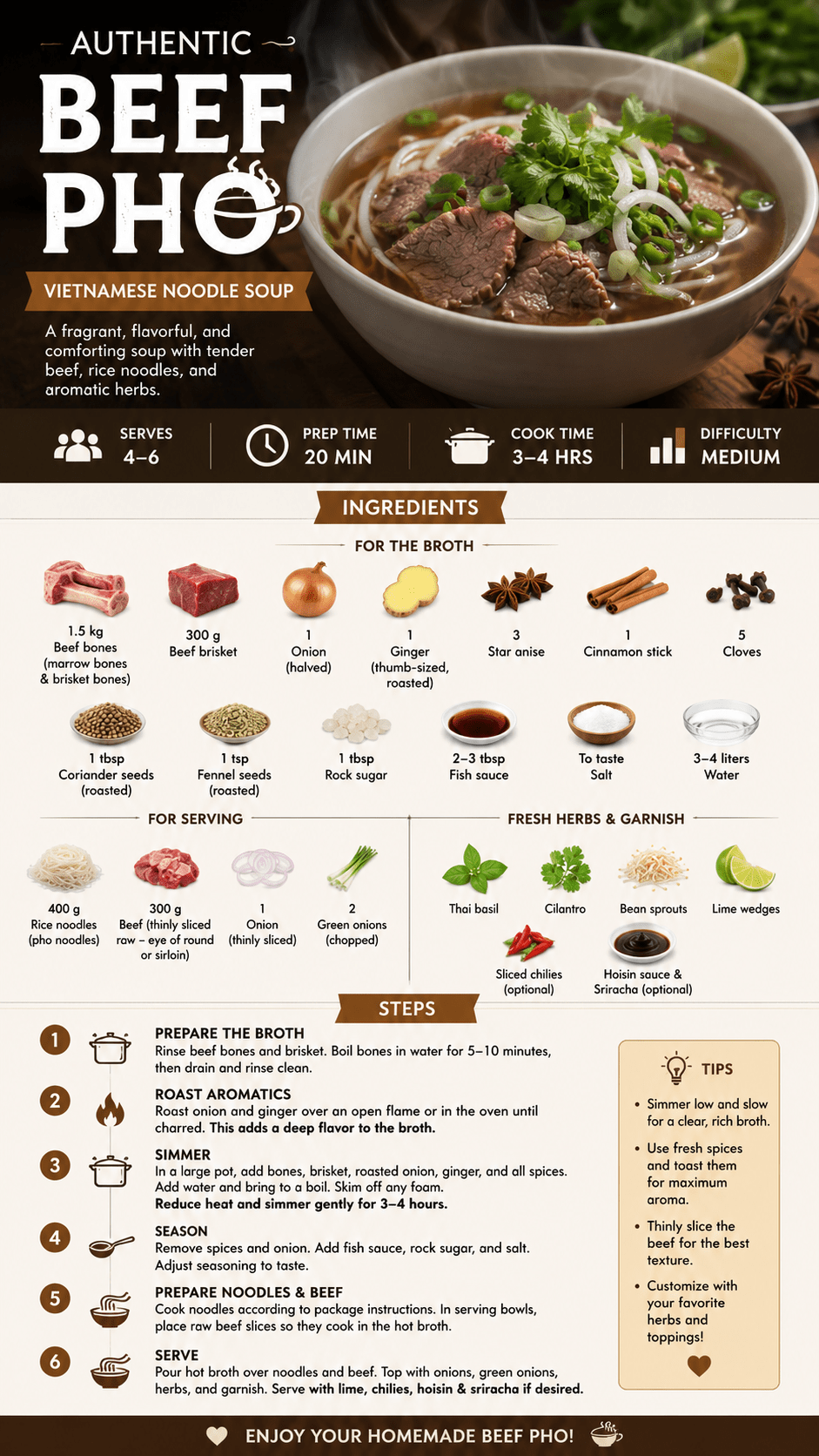
What You’ll Need
For the Broth
- 4 lbs beef bones (knuckle + marrow bones work great)
- 1 lb oxtail
- 1 large yellow onion, halved
- 3-inch piece of fresh ginger, halved lengthwise
- 3 cinnamon sticks
- 5 whole star anise
- 4 whole cloves
- 1 tbsp coriander seeds
- 1 tsp fennel seeds
- 3 tbsp fish sauce (plus more to taste)
- 1 tbsp sugar (rock sugar if you can find it)
- 1 tsp salt
- 12 cups water (plus extra for blanching)
For the Bowls
- 1 lb dried flat rice noodles (bánh phở, medium width)
- 1 lb beef eye of round or sirloin, very thinly sliced
- ½ lb beef brisket (optional, for extra richness)
Toppings (Pho Garnish Plate)
- Fresh bean sprouts
- Fresh Thai basil leaves
- Fresh cilantro
- 2–3 jalapeños or bird’s eye chilies, sliced
- 2 limes, cut into wedges
- 4 green onions, thinly sliced
- Hoisin sauce and sriracha (for the table)
Tools You’ll Need
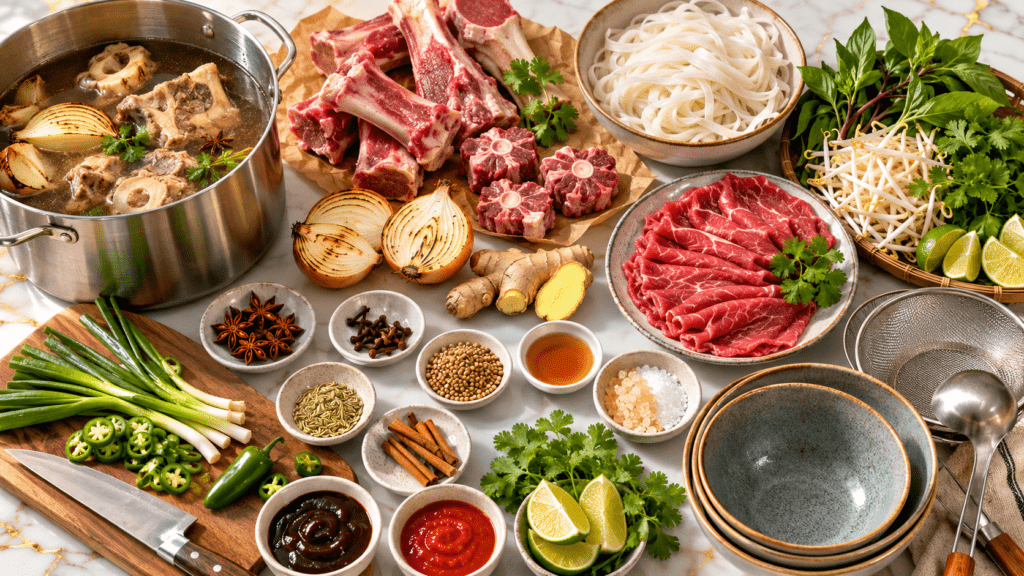
- Large stockpot (at least 8-quart)
- Tongs
- Baking sheet or cast iron skillet (for charring)
- Fine mesh strainer or cheesecloth
- Spider strainer or slotted spoon
- Ladle
- Sharp knife and cutting board
- Large mixing bowl (for soaking noodles)
- 4 large deep serving bowls
Pro Tips
1. Char the onion and ginger — no shortcuts here. This single step gives your broth that smoky-sweet depth that separates a good pho from an unforgettable one. Hold them over an open flame or broil them until they’re nicely blackened on the outside. It sounds like a small thing. It’s not.
2. Blanch the bones before you start the broth. This pulls out all the impurities that make broth murky and funky. Cover the bones in cold water, bring to a hard boil for 10 minutes, then dump the whole pot, rinse the bones, and start fresh. Your broth will be clear and clean.
3. Keep the broth at a bare simmer. A rolling boil makes the broth cloudy and greasy. You want tiny bubbles barely breaking the surface. Low and slow is the whole game here.
4. Freeze your raw beef slices for 15-20 minutes before cutting. This firms up the meat and makes it so much easier to get those paper-thin slices. A sharp knife helps too, but the freezing trick is the real move.
5. Taste and adjust at the end, not the beginning. Fish sauce, salt, and a pinch more sugar can completely transform a broth that feels “almost there.” Season in small amounts and taste as you go.
Make Ahead Tips
The broth is actually better the next day.
Make it a day ahead, let it cool completely, and refrigerate overnight. The fat will solidify on top and you can skim it right off, which gives you a leaner, cleaner broth.
Stored broth keeps in the fridge for up to 5 days and in the freezer for 3 months. If you’re batch cooking, this is one of the best recipes to freeze ahead.
Substitutions and Variations
| Swap | For | Notes |
|---|---|---|
| Oxtail | Short ribs | Same rich flavor, slightly different texture |
| Fish sauce | Soy sauce | Broth will be less funky but still delicious |
| Eye of round | Sirloin or ribeye | Ribeye adds more fat and richness |
| Rice noodles | Zucchini noodles | Works for low-carb versions |
| Regular sugar | Rock sugar | Rock sugar is more traditional, milder sweetness |
Chicken Pho: Swap beef bones for a whole chicken, reduce simmering time to 1.5 hours. Skip the oxtail.
Vegetarian Pho: Use charred onion, ginger, mushrooms, and a kombu-based broth. Add tofu instead of beef.
How to Make Beef Pho
Step 1: Blanch the Bones
Place the beef bones and oxtail in your large stockpot. Cover completely with cold water. Bring to a full boil over high heat and boil hard for 10 minutes.
Drain everything, discard the water, and rinse the bones well under cold water. Clean the pot too. This removes all the blood and impurities that make your broth cloudy.
Step 2: Char the Aromatics
Turn your oven broiler to high or use tongs over an open gas flame.
Place the halved onion and ginger cut-side-up on a baking sheet. Broil for 10-15 minutes until the edges are charred and caramelized. The outsides should look blackened, not just browned.
This step smells incredible and does more for your broth than almost anything else.
Step 3: Toast the Spices
In a dry skillet over medium heat, toast the cinnamon sticks, star anise, cloves, coriander seeds, and fennel seeds for 2-3 minutes until fragrant.
Stir constantly. They go from toasted to burned fast, so don’t walk away.
You can bundle them in a piece of cheesecloth tied with kitchen string, which makes them much easier to remove later.
Step 4: Build the Broth
Return the cleaned bones and oxtail to the pot. Add the charred onion and ginger. Add the toasted spice bundle.
Pour in 12 cups of water and bring to a boil over high heat. Once it boils, reduce heat immediately to the lowest setting. You want a gentle simmer, barely any movement.
Simmer for at least 3 hours, ideally 4-6. The longer it goes, the more deeply flavored the broth becomes.
During the first 30-45 minutes, skim any foam that rises to the surface.
Step 5: Season the Broth
After 3-4 hours, strain the broth through a fine mesh strainer into a clean pot. Discard the bones, spices, and aromatics.
If you cooked brisket in the broth, pull it out now, slice it, and set aside.
Season the strained broth with fish sauce, sugar, and salt. Start with what the recipe calls for, then taste and adjust. The broth should taste deeply savory with a slightly sweet, anise-forward aroma.
Bring back to a gentle simmer while you prep everything else.
Step 6: Prep the Noodles
Soak the dried rice noodles in room-temperature water for 30 minutes until pliable but not fully soft.
Bring a separate pot of water to a boil. Working in batches, cook soaked noodles for 1-2 minutes until just tender. Drain and divide between your serving bowls.
Step 7: Slice the Raw Beef
Remove your thinly sliced raw beef from the freezer. If you froze it, it should be firm enough to slice into almost translucent pieces.
Arrange slices over the noodles in each bowl. Don’t cook them yet, the hot broth does that for you.
Step 8: Assemble and Serve
Ladle the very hot broth directly over the raw beef and noodles. The heat will cook the raw slices within seconds as they hit the broth.
Top with sliced green onions and cilantro. Serve immediately with a garnish plate of bean sprouts, Thai basil, jalapeños, lime wedges, hoisin, and sriracha on the side.
The customization at the table is half the fun.
Nutritional Breakdown (Per Serving)
| Nutrient | Amount |
|---|---|
| Calories | ~520 kcal |
| Protein | 42g |
| Carbohydrates | 48g |
| Fat | 14g |
| Sodium | 1,100mg |
| Fiber | 2g |
Values are approximate and vary based on toppings and portion size.
Dietary notes:
- Gluten-free: Swap fish sauce for tamari and use GF hoisin
- Dairy-free: Already dairy-free as written
- High protein: Great post-workout meal
- Lower carb: Sub in zucchini noodles and reduce sugar to ½ tsp
Meal Pairing Suggestions
Pho is a full meal on its own, but if you’re making it for a dinner party:
- Vietnamese spring rolls as a starter
- Chè ba màu (Vietnamese three-color dessert) to finish
- Jasmine iced tea or a light lager to drink alongside
Leftovers and Storage
Broth: Store separately in an airtight container. Keeps in the fridge for 5 days, freezes for 3 months.
Cooked noodles: Store separately from the broth or they’ll absorb everything and turn mushy. Keeps for 2 days in the fridge.
Sliced raw beef: Keep refrigerated and use within 1-2 days. Do not freeze after slicing thin.
To reheat: Bring broth back to a simmer on the stovetop. Cook fresh or refrigerated noodles briefly in boiling water, then ladle hot broth over everything fresh.
FAQ
Can I use a slow cooker or Instant Pot for the broth?
Yes to both. For a slow cooker, cook on low for 8-10 hours after charring and blanching. For an Instant Pot, pressure cook on high for 2-3 hours. The stovetop version gives the most control over clarity, but both shortcuts work well.
Do I have to use oxtail?
You don’t have to, but it adds a gelatin richness that makes the broth feel silkier. If you skip it, add an extra pound of marrow bones to compensate.
Can I make this without charring the onion and ginger?
You can, but the broth won’t have the same depth. If you really can’t char them, roast them in the oven at 425°F for 20-25 minutes instead.
My broth is cloudy. What went wrong?
Usually one of two things: you didn’t blanch the bones first, or you simmered the broth too vigorously. A cloudy broth still tastes fine, it just won’t have that beautiful clear golden look.
How thin does the raw beef need to be?
As thin as you can get it. The hot broth barely cooks it to medium-rare within seconds. Thicker slices won’t cook through fast enough and can end up chewy.
Can I prep this for a crowd?
Absolutely. The broth scales well and keeps beautifully. Make a double batch of broth ahead of time and prep all your toppings the day before. Day-of assembly takes less than 20 minutes.
Wrapping Up
There’s a reason people fly to Vietnam just to eat a bowl of pho at 6am from a street vendor.
It’s not complicated food. It’s patient food. A broth that takes its time. A bowl that comes together in minutes but tastes like it’s been building for hours. Because it has.
Making it at home is one of those kitchen moments that feels genuinely impressive, even to yourself.
Give this one a go on a weekend when you have a few hours to let the broth do its thing. It’s a great recipe for a cozy dinner, a date night in, or when you really just want to eat something that feels like a warm hug in a bowl.
And when you make it? Drop a comment below and tell me how it went. Did you do the charring trick? Did you customize your toppings? Any questions or things you’d change? I read every single one. 👇