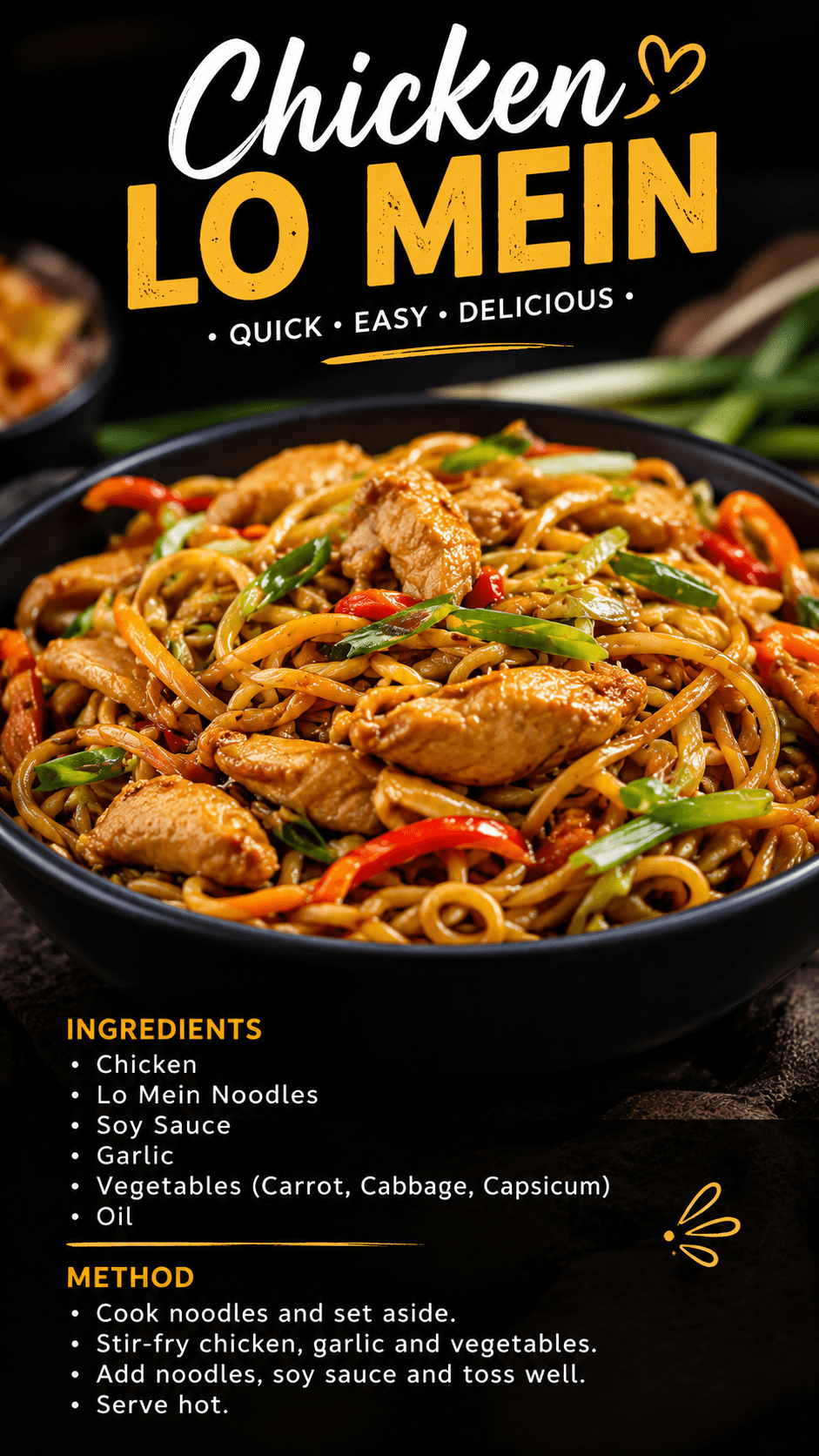
You spend $20 on Chinese takeout, wait 45 minutes, and get noodles that are somehow both mushy and dry at the same time.
Sound familiar?
This chicken lo mein recipe changed that for me. It’s faster than delivery, uses ingredients you can actually find at a regular grocery store, and the flavor? Genuinely better than most restaurants I’ve tried.
And yes, I know everyone says that about their homemade recipes. But stick with me here, because there’s one technique in this recipe that most people skip — and it’s the reason restaurant lo mein tastes so different from what you make at home.
More on that in a second. 👇
What Is Lo Mein, Actually?
A lot of people confuse lo mein with chow mein. They’re not the same.
Lo mein means “tossed noodles.” The noodles are cooked separately and then tossed with a sauce and other ingredients at the end.
Chow mein means “fried noodles.” The noodles get crisped up in the pan.
Lo mein is saucier, softer, and in my opinion, far more satisfying on a random Tuesday night. The noodles soak up all that savory, slightly sweet sauce and it’s… a lot.
What You’ll Need
For the Noodles & Chicken
- 8 oz lo mein noodles (or spaghetti as a swap)
- 1 lb boneless skinless chicken breast, thinly sliced
- 2 tablespoons soy sauce (for marinating the chicken)
- 1 tablespoon cornstarch
- 1 teaspoon sesame oil
For the Sauce
- 3 tablespoons soy sauce
- 2 tablespoons oyster sauce
- 1 tablespoon hoisin sauce
- 1 teaspoon sesame oil
- 1 teaspoon sugar
- 1 teaspoon cornstarch
- 2 tablespoons water
For the Stir Fry
- 2 tablespoons vegetable oil (divided)
- 3 garlic cloves, minced
- 1 teaspoon fresh ginger, grated
- 1 cup shredded cabbage
- 1 cup matchstick carrots
- 1 red bell pepper, thinly sliced
- 3 green onions, cut into 1-inch pieces
- 1 cup bean sprouts (optional)
Tools You’ll Need
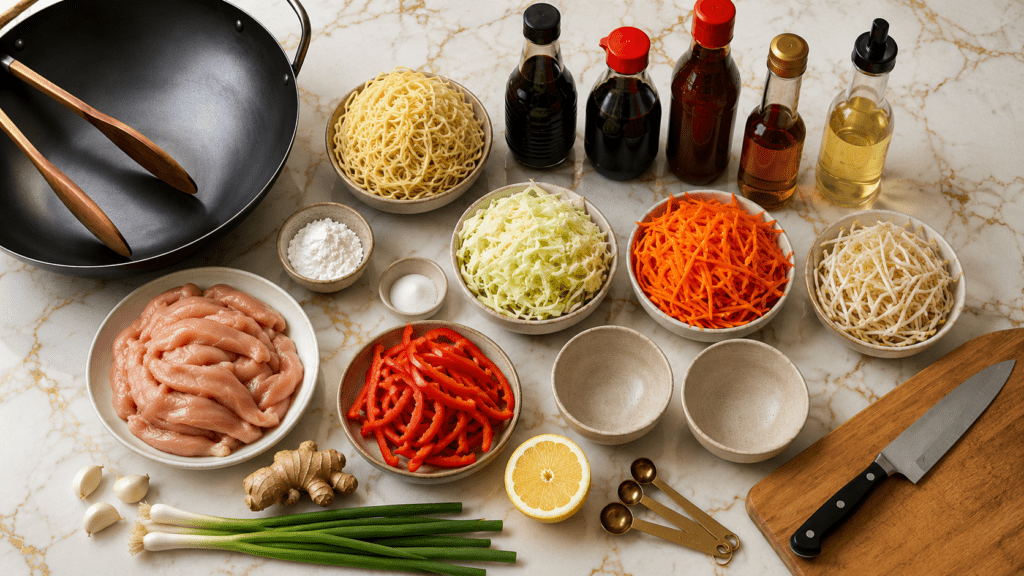
- Large wok or skillet (a wok is ideal, but a 12-inch skillet works fine)
- Large pot for boiling noodles
- Cutting board + sharp knife
- Two mixing bowls (one for marinade, one for sauce)
- Tongs or chopsticks
- Measuring spoons
Pro Tips
These are the things I wish someone had told me the first time I made lo mein.
1. Slice the chicken thin — and against the grain.
Thick pieces won’t cook fast enough in a wok. Thin slices cook in about 2-3 minutes and stay juicy. Cutting against the grain breaks up the muscle fibers so every bite is tender.
2. Don’t skip the cornstarch in the marinade.
This creates a light coating on the chicken that keeps moisture in during the high-heat cooking. It’s called “velveting” and it’s the secret behind that silky restaurant-quality texture.
3. Your pan needs to be screaming hot before anything goes in.
This is the biggest mistake home cooks make. A lukewarm pan steams your vegetables instead of searing them. You want high heat, a little smoke, and a fast cook.
4. Slightly undercook your noodles.
They’ll finish cooking when tossed with the hot sauce and vegetables. If you boil them all the way through, they’ll turn to mush by the time they hit the pan.
5. Mix the sauce before you start cooking.
Once the wok is hot, everything moves fast. You don’t want to be measuring soy sauce while your garlic is burning.
Substitutions and Variations
Noodles:
- Lo mein noodles → spaghetti, linguine, or rice noodles (for gluten-free)
- Fresh noodles work even better than dried if you can find them
Protein:
- Chicken → shrimp, beef, tofu, or just extra vegetables
- Pork tenderloin also works really well here
Vegetables:
- Use whatever you have. Broccoli, snap peas, mushrooms, zucchini, and baby bok choy all work great
- Frozen mixed stir-fry vegetables are a totally valid shortcut
Sauce:
- No oyster sauce? Substitute with more hoisin or a splash of fish sauce
- For a lower-sodium version, use low-sodium soy sauce and reduce the oyster sauce by half
- Want heat? Add a teaspoon of chili garlic sauce or a few dashes of sriracha
Make Ahead Tips
The sauce can be mixed and stored in a jar in the fridge for up to a week. Having it pre-made makes weeknight dinners so much faster.
The chicken can be marinated for up to 24 hours. Longer than that and the texture can get a little off.
The vegetables can be prepped and stored in an airtight container in the fridge for 2-3 days. Slice everything ahead of time and the actual cooking takes under 15 minutes.
Nutritional Info (Per Serving, Approx.)
| Nutrient | Amount |
|---|---|
| Calories | ~480 |
| Protein | 32g |
| Carbohydrates | 52g |
| Fat | 14g |
| Sodium | 980mg |
| Fiber | 3g |
Based on 4 servings. Using low-sodium soy sauce drops the sodium significantly.
Diet-Friendly Swaps
- Gluten-free: Rice noodles + tamari instead of soy sauce + gluten-free oyster sauce
- Dairy-free: Already dairy-free as written
- Lower carb: Use zucchini noodles (zoodles) or shirataki noodles and double the protein
- Vegetarian/Vegan: Swap chicken for firm tofu and use vegan oyster sauce (it exists and it’s good)
Meal Pairing Suggestions
- Egg drop soup or hot and sour soup as a starter
- Steamed dumplings or spring rolls on the side
- Cucumber salad with rice vinegar as a refreshing contrast
- Jasmine tea or a light lager to drink
How to Make Chicken Lo Mein
Step 1: Marinate the Chicken
Combine the sliced chicken with 2 tablespoons soy sauce, 1 tablespoon cornstarch, and 1 teaspoon sesame oil.
Toss to coat and let it sit for at least 15 minutes. If you have 30 minutes, even better.
Step 2: Mix the Sauce
In a small bowl, whisk together the soy sauce, oyster sauce, hoisin sauce, sesame oil, sugar, cornstarch, and water until smooth.
Set it right next to your stove. You’ll need it fast.
Step 3: Cook the Noodles
Boil your lo mein noodles according to the package instructions, but pull them out about 1 minute early.
Drain, rinse with cold water (this stops cooking and prevents sticking), and toss with a tiny bit of oil.
Step 4: Cook the Chicken
Heat 1 tablespoon of vegetable oil in your wok or skillet over high heat until it’s shimmering and almost smoking.
Add the chicken in a single layer. Let it sear for 1-2 minutes without moving it — this is how you get color on the outside. Then flip and cook another 1-2 minutes until cooked through.
Remove the chicken and set aside.
Step 5: Stir Fry the Vegetables
Add the remaining 1 tablespoon of oil to the same pan. Still on high heat.
Add garlic and ginger first and stir for about 30 seconds — just until fragrant. Then add the carrots, cabbage, and bell pepper. Stir fry for 2-3 minutes until they’re just tender but still have a little bite.
Step 6: Bring It All Together
Add the cooked noodles and chicken back to the pan. Pour the sauce over everything.
Toss everything together for 1-2 minutes until the noodles are coated and the sauce has thickened slightly. Add the green onions and bean sprouts in the last 30 seconds so they stay bright and fresh.
Step 7: Taste and Adjust
Give it a taste. Need more salt? Add a splash of soy sauce. Needs brightness? A small squeeze of lime works great. More heat? Drizzle in some chili oil.
Serve immediately.
Leftovers and Storage
Fridge: Store in an airtight container for up to 3-4 days. The noodles will absorb more sauce as they sit, which honestly makes them even more flavorful.
Freezer: Not recommended. The noodle texture gets pretty sad after freezing.
Reheating: Toss in a hot pan with a splash of water or chicken broth to loosen things up. The microwave works, but the pan brings back that just-cooked texture way better.
Meal prep note: If you’re planning to eat this throughout the week, store the noodles and sauce separately if possible. Combine when you’re ready to eat.
FAQ
Can I use spaghetti instead of lo mein noodles?
Yes, and it works really well. Cook spaghetti to just al dente, rinse it, and you’d honestly never know the difference once it’s in the sauce.
My sauce tastes too salty. What do I do?
Add a little more sugar or a squeeze of lime juice to balance it. A splash of water or unsalted chicken broth also helps dilute it.
Why is my chicken chewy?
Two likely reasons: it was cut too thick, or it cooked too long. Thin slices on high heat for 3-4 minutes total is all you need. Overcooking chicken breast makes it tough.
Can I make this ahead for a party?
Yes, but cook everything slightly under. When you reheat it for the party, toss it in a hot pan with an extra splash of sauce so it doesn’t dry out.
My vegetables are soggy. What went wrong?
The pan wasn’t hot enough, or there was too much food in it at once. Both cause steaming instead of searing. Cook in batches if your pan isn’t huge.
Is lo mein actually Chinese?
Yes. Lo mein originated in Chinese cuisine and the name comes from Cantonese. What you get at American-Chinese restaurants is a slightly adapted version — a bit sweeter and saucier than what you’d find in China.
Can I double this recipe?
Totally, but cook the chicken and vegetables in batches. Crowding the wok kills the heat and you end up steaming everything.
Wrapping Up
This chicken lo mein is the kind of meal that makes you feel like you really figured something out.
You made a restaurant-quality dish, in your own kitchen, in about 30 minutes — and it cost a fraction of what takeout would have been.
Once you try the velveting technique with the cornstarch marinade, you’ll start using it with every stir fry you make. It’s a total game changer and nobody talks about it enough.
Give it a try this week and come back and leave a comment below. Tell me how it went, what variations you tried, and any questions you run into. I read every single one and I genuinely love hearing what works for people. 🍜