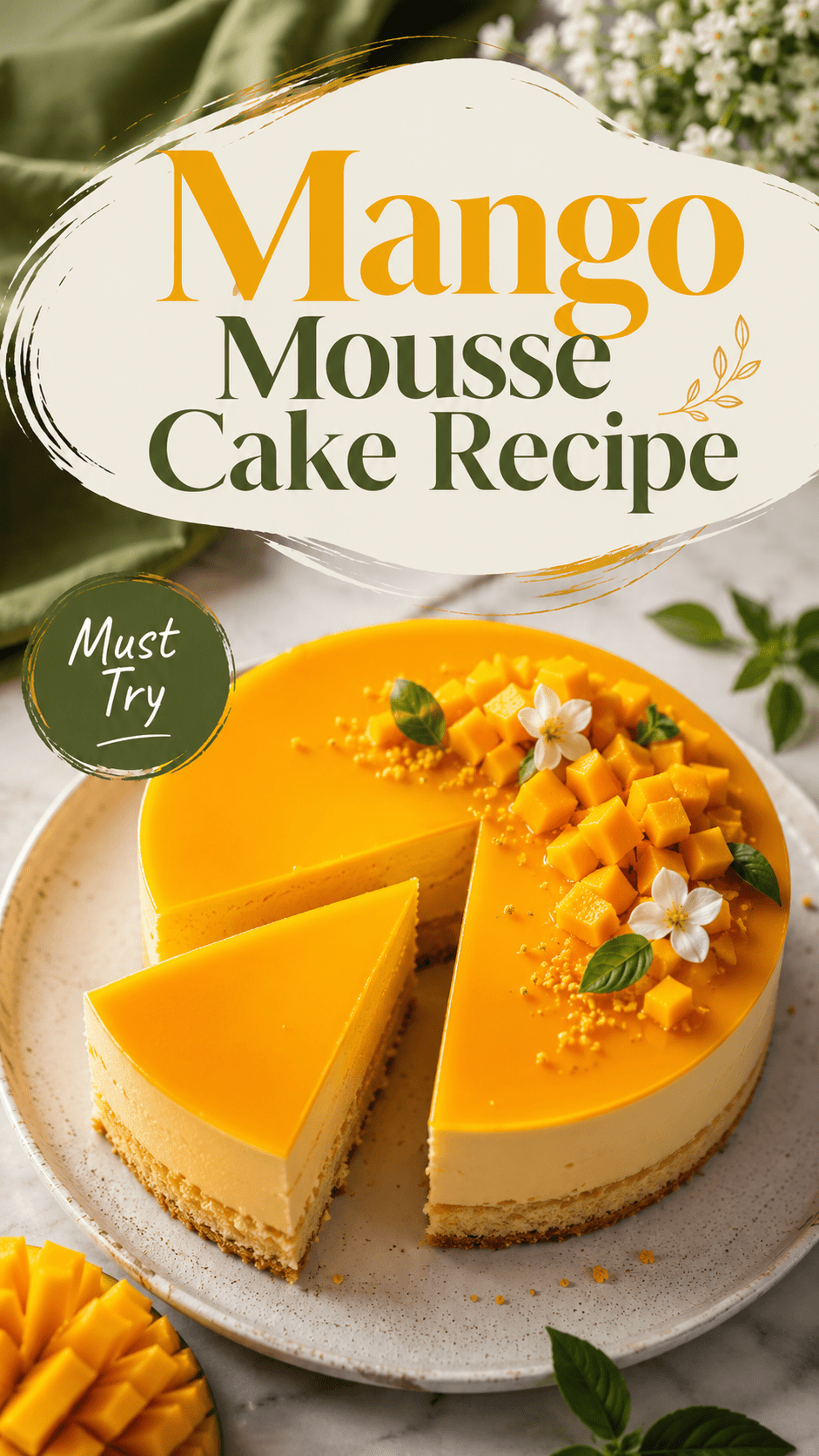
I made this cake for a dinner party once and completely forgot to mention it was no-bake.
Someone asked what oven temp I used. I just smiled and changed the subject.
That’s the thing about mango mousse cake. It looks like it took hours. It tastes like it took hours. And it takes about 25 minutes of actual work, plus a lot of very patient waiting in your fridge.
If you’ve never made a mousse cake before, this is honestly one of the easiest ones to start with. No gelatin sheets to soak and fuss over (well, a little bit, but I’ll walk you through it). No water bath. No cracked-top anxiety.
Just ripe mango, cream, a crunchy cookie base, and a fridge that does most of the work for you.
Let’s get into it.
What You’ll Need
For the crust:
- 2 cups graham cracker crumbs (about 16 full sheets, crushed)
- 6 tablespoons unsalted butter, melted
- 2 tablespoons granulated sugar
- Pinch of salt
For the mango mousse:
- 3 cups ripe mango, pureed (about 3-4 large mangoes, or 2 cups frozen mango chunks, thawed)
- 1/2 cup granulated sugar
- 2 1/2 teaspoons unflavored gelatin powder
- 3 tablespoons cold water
- 1 1/2 cups heavy cream, cold
- 1 tablespoon lime juice
- 1/4 teaspoon salt
For the topping (optional but pretty):
- 1 cup fresh mango, diced small
- Mint leaves
- A little extra mousse mixture, piped, if you’re feeling fancy
Tools You’ll Need
- 8 or 9-inch springform pan
- Blender or food processor
- Stand mixer or hand mixer
- Rubber spatula
- Small saucepan (or the microwave, honestly)
- Plastic wrap
Pro Tips
1. Your mango needs to actually be ripe. Not “it’ll ripen on the counter eventually” ripe. If it’s not sweet and fragrant now, your mousse won’t be either. Taste your puree before you commit.
2. Bloom your gelatin properly. Sprinkle it over cold water and let it sit for 5 minutes until it looks like wet sand. Skip this step and you’ll get weird gelatin clumps in your finished mousse. Not cute.
3. Fold, don’t stir. When you combine the whipped cream with the mango mixture, use a gentle folding motion. Stirring knocks all the air out, and that air is basically the whole reason it’s called a “mousse” and not “mango pudding.”
4. Chill the cake for the full time. I know. I know. But 6 hours minimum (overnight is better) is what gives you clean slices instead of a mango puddle on the plate.
5. Run your knife under hot water before slicing. Wipe it dry, cut, repeat. This one trick makes every slice look like it came from a bakery.
How to Make It
Step 1: Make the crust
Mix the graham cracker crumbs, melted butter, sugar, and salt in a bowl until it looks like wet sand.
Press it firmly into the bottom of your springform pan. I use the bottom of a measuring cup to really pack it down.
Pop it in the fridge while you work on the mousse.
Step 2: Bloom the gelatin
Sprinkle the gelatin powder over the cold water in a small bowl.
Let it sit for 5 minutes, untouched. It’ll turn into a solid, wrinkly looking mass. That’s exactly what you want.
Step 3: Warm the gelatin
Microwave the bloomed gelatin for about 10-15 seconds, or set the bowl in a bit of simmering water, until it turns fully liquid. Don’t let it boil.
Step 4: Mix the mango base
In a large bowl, whisk together the mango puree, sugar, lime juice, and salt.
Slowly whisk in the melted gelatin. Do this while the gelatin is still warm so it doesn’t seize up into little strings.
Step 5: Whip the cream
In a separate bowl, whip the cold heavy cream until it holds soft peaks. Not stiff, not stiff-and-grainy. Soft peaks that gently fold over when you lift the whisk.
Step 6: Fold everything together
Add about a third of the whipped cream into the mango mixture and stir it in to loosen things up.
Then gently fold in the rest of the whipped cream in two batches, until no white streaks remain.
Step 7: Assemble
Pour the mousse over your chilled crust. Smooth the top with a spatula.
Cover with plastic wrap (don’t let it touch the surface) and refrigerate for at least 6 hours, ideally overnight.
Step 8: Decorate and serve
Once set, run a hot, dry knife around the edge of the pan before releasing the springform.
Top with diced fresh mango and a few mint leaves right before serving.
Substitutions and Variations
| Original | Swap | Notes |
|---|---|---|
| Graham cracker crust | Digestive biscuits or vanilla wafers | Same ratio of butter works fine |
| Heavy cream | Coconut cream (chilled overnight, solid part only) | Makes it dairy-free, adds a nice coconut edge |
| Gelatin | Agar agar powder | Use half the amount, and bring it to a boil for 1-2 minutes to activate, unlike gelatin |
| Fresh mango | Frozen mango, thawed | Works great, just drain excess liquid before pureeing |
| Lime juice | Lemon juice | A little less bright, but still balances the sweetness |
| Graham crust | Crushed oreos (filling removed) | Gives you a totally different, chocolatey base |
Make Ahead Tips
This cake practically wants to be made ahead. Actually, it needs to be.
Make it up to 2 days before you plan to serve it, and keep it covered in the fridge.
You can also freeze the assembled, un-decorated cake for up to a month. Thaw it in the fridge overnight, then add your fresh mango topping right before serving.
Nutrition (Per Slice, 12 Slices Total)
| Nutrient | Amount |
|---|---|
| Calories | 290 |
| Total Fat | 18g |
| Saturated Fat | 11g |
| Carbohydrates | 30g |
| Sugar | 22g |
| Protein | 3g |
| Fiber | 1g |
Estimates only, and they’ll shift depending on your exact mango and crust choices.
Leftovers and Storage
Cover leftover slices tightly and keep them in the fridge for up to 4 days. The crust does soften a little over time, but honestly it’s still good on day 4.
I don’t recommend freezing individual slices once they’re topped with fresh fruit. The fruit gets watery when it thaws. Freeze the whole cake before topping if you want a longer shelf life.
FAQ
Can I make this without gelatin?
Yes, agar agar works as a plant-based substitute. Use about half the amount and bring the mixture to a boil for a minute or two, since agar needs heat to activate properly, unlike gelatin which just needs to melt.
Why is my mousse runny?
A few possible reasons. Your cream might not have been whipped enough, your gelatin might not have fully bloomed or melted, or the cake simply hasn’t chilled long enough. Give it the full 6 hours before you panic.
Can I use canned mango puree?
You can, though I’d recommend cutting the added sugar in the recipe by half, since canned puree is usually already sweetened.
Do I need a springform pan?
It makes life easier, but a regular cake pan lined with plastic wrap and enough overhang to lift the cake out works too.
Can I make individual mini cakes instead?
Definitely. Use a muffin tin lined with liners, or small mason jars for a no-unmolding version. Adjust the chill time down slightly since smaller portions set faster.
Wrapping Up
There’s a very specific kind of satisfaction that comes from slicing into this cake and watching that clean, bright orange layer hold its shape.
It’s the kind of dessert that gets a reaction before anyone’s even tasted it.
Give it a try, and let me know in the comments how it turned out for you. And if you ran into any hiccups along the way, ask away, I’m happy to help troubleshoot.