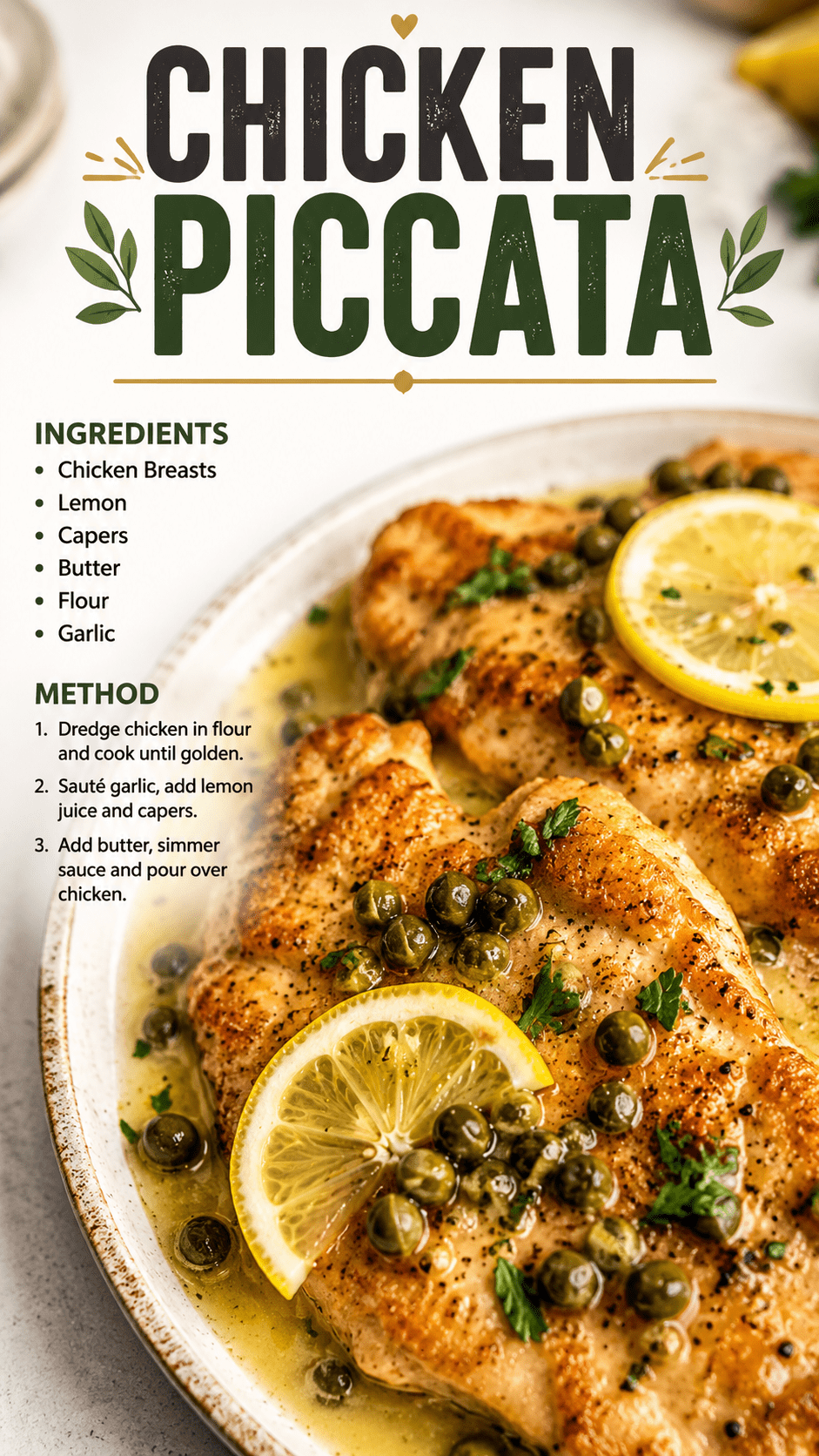
I made this for my husband the first time and he asked if I’d been secretly taking cooking classes.
I hadn’t. I’d just learned the one trick that makes chicken piccata taste like a restaurant dish instead of sad chicken with lemon on it.
And once you know that trick, this recipe takes about 30 minutes start to finish.
Chicken piccata is thin chicken cutlets, pan fried until golden, then bathed in a butter sauce made from lemon, capers, and white wine. It sounds fancy. It’s really not.
I’d actually never made it before that night. I’d only ever ordered it at restaurants, the kind where you feel a little guilty asking for the bread basket twice.
So I looked up a handful of recipes, picked out the parts that made sense, and just went for it.
The first attempt was good. The second attempt, after I figured out the butter trick, was the one that made my husband stop mid-bite and ask what I did differently.
This is the kind of dinner you make on a random Tuesday and suddenly feel like your life is more put together than it actually is. 🍋
Let’s get into it.
What You’ll Need
For the chicken:
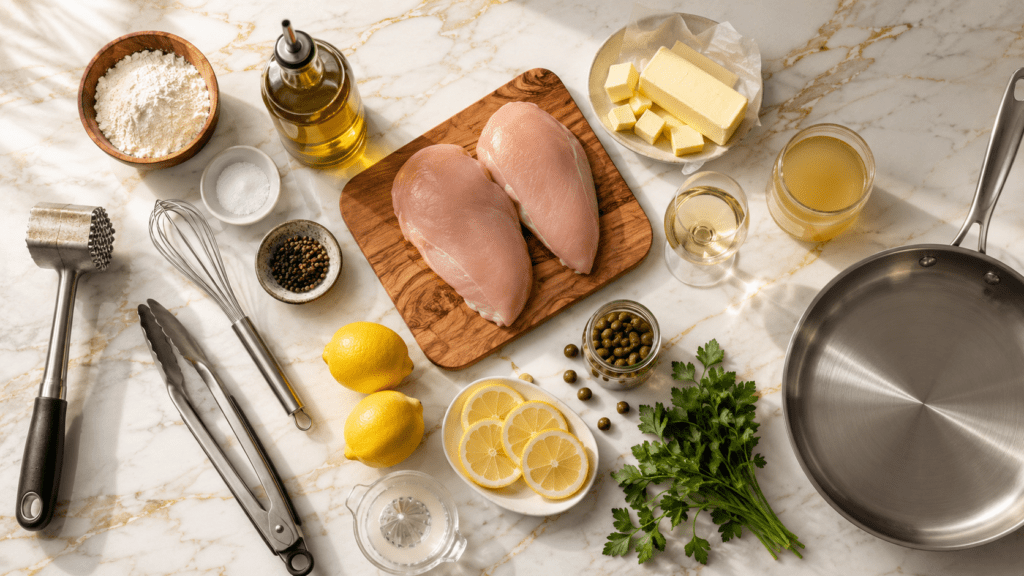
- 2 large boneless, skinless chicken breasts (about 1.5 lbs)
- 1/2 cup all-purpose flour
- 1/2 tsp salt
- 1/4 tsp black pepper
- 3 tbsp olive oil
- 2 tbsp unsalted butter
For the sauce:
- 1/3 cup dry white wine (Sauvignon Blanc works great)
- 1/2 cup low-sodium chicken broth
- 3 tbsp fresh lemon juice (about 1 large lemon)
- 1/4 cup capers, drained
- 3 tbsp unsalted butter, cold and cut into cubes
- 2 tbsp fresh parsley, chopped
- Lemon slices, for garnish
Quick table version if you’re scanning:
| Ingredient | Amount |
|---|---|
| Chicken breasts | 2 large (1.5 lbs) |
| Flour | 1/2 cup |
| Olive oil | 3 tbsp |
| Butter (divided) | 5 tbsp total |
| White wine | 1/3 cup |
| Chicken broth | 1/2 cup |
| Lemon juice | 3 tbsp |
| Capers | 1/4 cup |
| Parsley | 2 tbsp |
Tools You’ll Need
- A large skillet (stainless steel or cast iron, not nonstick. You want those golden bits stuck to the pan)
- A meat mallet or rolling pin
- Tongs
- A whisk
- Measuring cups and spoons
- A cutting board and sharp knife
How To Make Chicken Piccata
Step 1: Pound the chicken thin.
Slice each chicken breast in half horizontally to make 4 thinner pieces.
Place them between two sheets of plastic wrap and pound them with a mallet until they’re about 1/4 inch thick.
This is the step everyone skips. Don’t skip it.
Step 2: Season and flour.
Mix the flour, salt, and pepper on a plate.
Dredge each chicken piece in the flour mixture, shaking off the extra. You want a light coat, not a heavy crust.
Step 3: Sear the chicken.
Heat the olive oil and 2 tbsp butter in your skillet over medium-high heat.
Once it’s shimmering, add the chicken in batches (don’t crowd the pan).
Cook for 3 to 4 minutes per side, until golden brown and cooked through.
Move the chicken to a plate and cover loosely with foil.
Step 4: Build the sauce.
In the same pan (don’t wipe it out, that’s where the flavor lives), add the white wine.
Scrape up all those browned bits with your whisk while it simmers for 2 minutes.
Step 5: Add the rest.
Pour in the chicken broth, lemon juice, and capers.
Let it simmer for 3 to 4 minutes until it reduces slightly.
Step 6: Finish with butter.
Turn the heat to low and whisk in the cold butter cubes, one at a time.
This is what makes the sauce silky instead of watery. It’s called a beurre blanc technique, and it’s the actual secret behind every good piccata.
Step 7: Bring it together.
Add the chicken back into the pan and spoon the sauce over top.
Sprinkle with parsley and add a few lemon slices for looks.
Serve immediately.
Pro Tips
I’ve made this recipe more times than I can count, so here’s what actually matters:
- Cold butter is non-negotiable. Room temp butter will make your sauce greasy instead of glossy. Keep it in the fridge until the second you need it.
- Don’t skip the dredge shake-off. Too much flour clinging to the chicken turns your sauce gummy instead of silky.
- Use a pan you can deglaze. Nonstick pans don’t release those caramelized bits, and that’s most of your flavor.
- Buy capers in brine, not salt-packed, unless you plan to rinse them first. Salt-packed capers will make the dish way too salty.
- Let the chicken rest while you make the sauce. It keeps the juices in and gives the sauce time to actually thicken.
I learned the cold butter thing the hard way. My first attempt at this sauce came out thin and a little oily, almost like it had separated.
Turns out that’s exactly what happened. The butter melted too fast because the pan was still too hot.
Once I started pulling the pan off the heat slightly and whisking in cold cubes one at a time, the sauce turned glossy and thick almost instantly. It was such a small change that made such a big difference.
Substitutions and Variations
- No white wine? Use extra chicken broth with a splash of white wine vinegar instead.
- Gluten-free? Swap the all-purpose flour for a 1:1 gluten-free flour blend.
- No capers on hand? Chopped green olives give a similar salty bite, though it’s a different flavor profile.
- Chicken thighs instead of breasts work too, just pound them thin the same way.
- Want it dairy-free? Use a dairy-free butter alternative. The sauce won’t be quite as rich, but it’ll still work.
- Add mushrooms to the sauce in step 4 for an earthier variation people go crazy for.
- Make it spicy with a pinch of red pepper flakes added in with the capers, if you like a little heat cutting through the richness.
- Swap chicken for veal or pork cutlets if you want to try the dish closer to how it’s made in some Italian kitchens.
Make Ahead Tips
You can pound and flour the chicken up to 4 hours ahead. Keep it covered in the fridge until you’re ready to cook.
The sauce, though, is best made fresh. Butter sauces don’t reheat well, they tend to separate.
If you want to meal prep, just sear the chicken ahead and make the sauce right before serving.
Nutritional Breakdown (Per Serving, Serves 4)
| Nutrient | Amount |
|---|---|
| Calories | ~390 |
| Protein | 34g |
| Fat | 22g |
| Carbohydrates | 9g |
| Sodium | 520mg |
These numbers will shift slightly depending on the butter and oil you use, but this gives you a solid ballpark.
What To Serve With Chicken Piccata
This dish practically begs for something to soak up that lemon butter sauce.
- Angel hair pasta is the classic pairing
- Garlic mashed potatoes if you want something heartier
- Crusty bread for the people who just want to mop up every drop (me, always)
- A simple arugula salad with lemon vinaigrette to balance the richness
- Steamed asparagus or green beans for a lighter veggie side
Leftovers and Storage
Store leftover chicken piccata in an airtight container in the fridge for up to 3 days.
Reheat gently on the stovetop over low heat. The microwave works in a pinch, but it can make the sauce separate a little.
I wouldn’t recommend freezing this one. The sauce just doesn’t come back the same way once it’s been frozen and thawed.
FAQ
Why is my sauce breaking or looking oily instead of smooth?
This usually means your butter melted too fast over high heat. Keep the heat low when you add it, and whisk constantly.
Can I use bottled lemon juice instead of fresh?
You can, but fresh really does make a difference here. The brightness fades fast in bottled juice.
What’s the difference between piccata and scallopini?
Scallopini just refers to thin cutlets of meat. Piccata specifically means it’s made with that lemon, butter, and caper sauce.
Is chicken piccata supposed to be very lemony?
Yes, it’s meant to be bright and tangy. If yours tastes flat, you probably need a touch more fresh lemon juice.
Can I double this recipe for a dinner party?
Definitely, just sear the chicken in batches so you don’t crowd the pan, and make the sauce in one batch after.
Why did my chicken turn out tough?
This almost always comes down to overcooking or skipping the pounding step. Thin, evenly pounded chicken cooks fast and stays tender.
Can I make this ahead for guests?
You can prep everything ahead, but I’d cook it the day of. The sauce really shines when it’s fresh off the stove.
Wrapping Up
Chicken piccata looks like the kind of dish you’d order at a nice restaurant and quietly assume you could never make at home.
You can. And now you know exactly how.
It really comes down to a few simple steps done right, thin chicken, a light dredge, and that cold butter trick that turns a basic pan sauce into something silky and rich.
Give this one a try this week, even if it’s just a regular Tuesday that needs a little help.
Then come back and tell me how it turned out in the comments. I want to know if your sauce came out silky, if you added mushrooms, and what you served it with.